
In Singapore, dengue is a familiar and persistent public health concern. Remove stagnant water, use mosquito repellent and take precautions against mosquito bites – these are the common advice that we hear. For years, prevention has largely meant avoiding mosquito bites and reducing mosquito breeding.
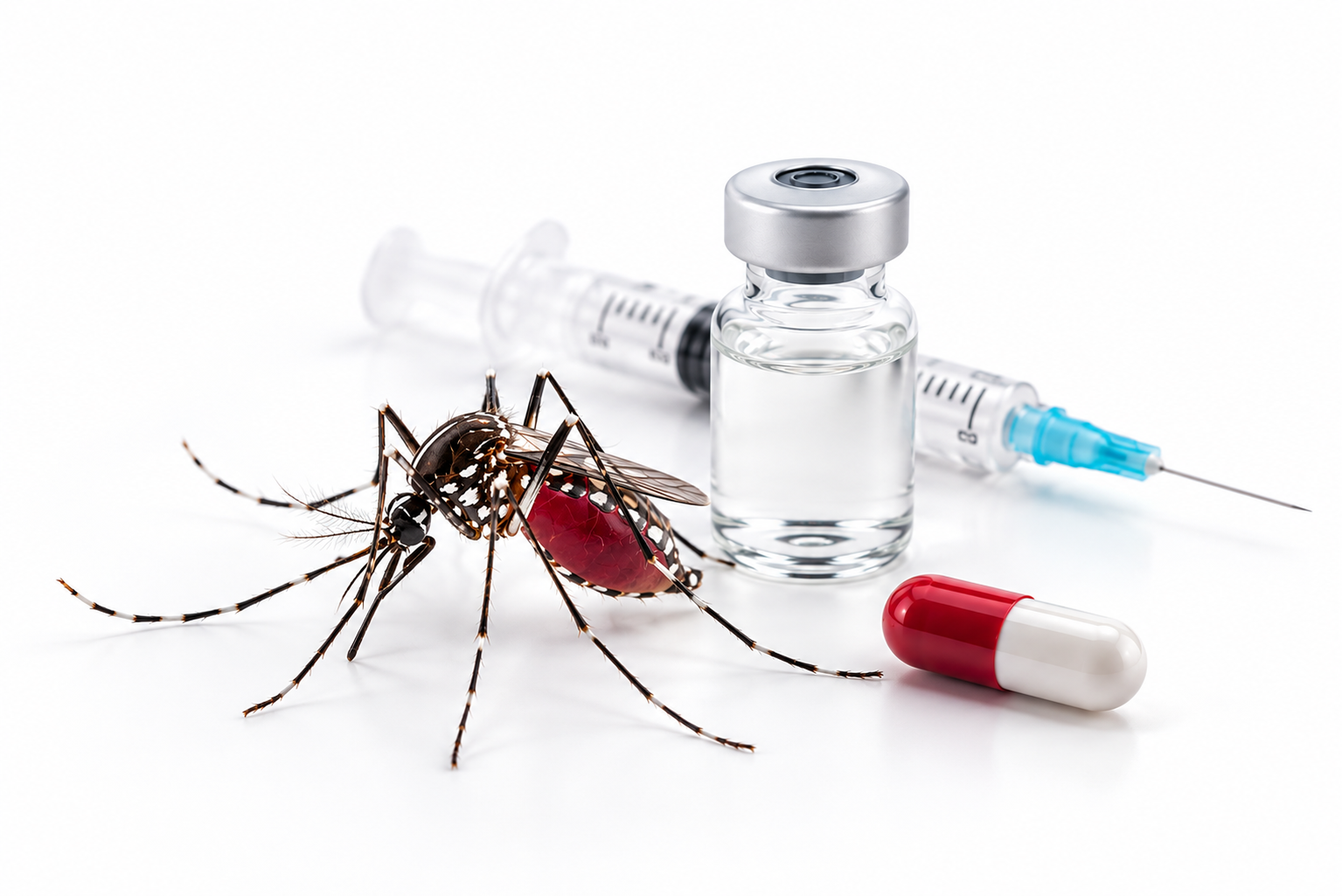
Dengue research has been steadily advancing. Newer vaccines, preventive anti-viral tablets, and improved control measures for mosquito transmission are now being explored.
Vaccines: Getting Closer to Better Protection
Developing a dengue vaccine is challenging because there are four different dengue virus serotypes — DENV-1, DENV-2, DENV-3 and DENV-4, and our immune response to one can affect how we respond to another.
The first dengue vaccine, Dengvaxia, taught an important lesson. Clinical trials showed that people who had previously been infected with dengue could benefit from vaccination, while those who had never had dengue before could face a higher risk of developing severe dengue if they were later infected.
Newer vaccines are trying to overcome these challenges. Qdenga (TAK-003), a two-dose live attenuated vaccine, has shown good protection particularly against DENV-2, although protection varies with other serotypes.
Another promising option is the Butantan-live attenuated Dengue Vaccine, which is given as a single dose. A large study in Brazil showed encouraging protection against two common types of dengue virus, DENV-1 and DENV-2, even in people who had never had dengue before. However, there were too few cases of DENV-3 and DENV-4 in the study to know how well the vaccine protects against these two types.
The search therefore continues for a safe, highly effective vaccine that can provide broad protection against all four dengue serotypes, ideally with a single dose.
Could a Tablet Prevent Dengue?
Perhaps the most interesting recent development is mosnodenvir, an experimental oral antiviral being studied for dengue prevention/”prophylaxis”.
Unlike a vaccine, which prepares the immune system in advance, mosnodenvir acts directly against the dengue virus and interferes with its ability to replicate by blocking 2 viral proteins. This could potentially offer rapid, short-term protection during dengue outbreaks or periods of increased dengue risk.
In a small controlled study, participants receiving the highest dose of mosnodenvir had significantly lower DENV-3 viral load, compared to those receiving placebo.
The findings are promising, but mosnodenvir is still experimental. Larger real-world studies are needed to establish how well it works against naturally acquired dengue and to better understand issues such as anti-viral resistance.
Tackling Dengue at the Mosquito Level
What if we could prevent dengue before an infected mosquito ever gets the chance to bite us?
Traditional dengue prevention focuses on removing breeding sites and avoiding mosquito bites. Newer strategies are taking this a step further by targeting the mosquito population itself.
One example is the use of Singapore’s Project Wolbachia: which involves releasing Wolbachia-carrying male Aedes aegypti mosquitoes. These male mosquitoes do not bite. When these males mate with female mosquitoes in the community, their eggs do not hatch, gradually reducing the number of Aedes aegypti mosquitoes that can spread dengue.
This adds another layer to dengue prevention: vaccines build immunity, preventive medicines may stop the virus from multiplying, while mosquito suppression tackles dengue at its source of transmission.
So, What Might the Future Look Like?
There will not be one single solution to prevent and control dengue.
The future could involve a combination of vaccination for longer-term protection, anti-viral tablets for periods of higher risk, and mosquito-control strategies to reduce transmission in the community.
For now, preventing mosquito bites and breeding remains important. But after decades of limited options, the dengue prevention toolkit may finally be getting bigger.
References
- Halstead SB. Three Dengue Vaccines — What Now? New England Journal of Medicine. 2024;390:464–465. doi:10.1056/NEJMe2314240.
- Durbin AP, Van Wesenbeeck L, Pierce KK, et al. Daily Mosnodenvir as Dengue Prophylaxis in a Controlled Human Infection Model. New England Journal of Medicine. 2025;393:2107–2118. doi:10.1056/NEJMoa2500179.
- National Environment Agency (Singapore). Wolbachia-Aedes Mosquito Suppression Strategy – Project Wolbachia Singapore. Accessed 11 September 2026: https://www.nea.gov.sg/corporate-functions/resources/research/environmental_health_institute/wolbachia-aedes-mosquito-suppression-strategy